Saturday, July 12, 2008

Getting Down to Work

I officially started my documentation project yesterday. Earlier, I had pitched an idea to shoot a promotional documentary that the country director could use to keep a record of field projects and hopefully to help push the donors our way when it comes time to renew several of the grants that the Sudan office relies upon for its operations. As I had been struggling before to define for myself my job for the next two months, I latched onto the project as a way to focus my energy while I sort of tread water in the short term.

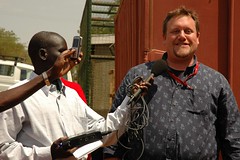
Early yesterday morning, I met Jeffa, the Pagak area community health organizer, at the compound. Duncan and he had arranged for me to meet and interview a mother, whose young son had about a month long stay at the Public Health Community Center with burns on 40% of his small body. I walked with Jeffa the few minutes it takes to get from the compound to the PCHH. The PHCC was pretty empty as is often the case. The PCHH only receives a case or two per day—usually Malaria. A few SPLA soldiers were hanging out, lying on the benches outside one of the buildings and chatting with one another. I met the mother who was sitting in front of the hospital wing—there are two rooms with about five beds each, one for the men and one for the women. We greeted, shook hands, and I explained what the project was for and expressed my appreciation for her willingness to talk with me.

I was a bit nervous—this was my first case for the documentary. The mother’s smile and the happy boy, who was maybe only about a year or two old and being bounced around on his mother’s lap. I started to get all my equipment together and was utterly unprepared as the mother started to take of the child’s clothes, revealing a near continuous scar that ran from his side and back all the way down his leg. An overwhelming sense of what the boy must have felt at the time washed over me and yet I was entirely unable to empathize with such a feeling of pain.

I clumsily set everything up and did a very short interview. Nothing too much, just tried my best to get the child’s story and be respectful of him and his mother. Even with Jeffa there to translate, the details were hard to follow. I was still distracted. The child had been burned with either hot water, hot oil, or hot something that the child had knocked over onto his body. His mother took him to the PHCC afterwards. Luckily an American couple had visited the PHCC a few months back and left some medical supplies—specifically anti-bacterial gel and disinfectant. During his month stay at the clinic, those supplies saved his life.

I later interviewed Jeffa about the child’s case as well as the services the PHCC provides the community. The PHCC was only finished this year. “Before then, the child would have died,” he told me. Such a thing had just happened a few months ago and too many times in the past years.

I thanked everybody there, especially the mother, who was very grateful even though I had no role in her son’s treatment or recovery. I will hopefully be working out of the clinic more in the future as I start to figure out with Duncan our plan for community health mobilization.

Next stop was over at the Nile Interdevelopment Program (NIP) compound, where Judith, Odongo, and Titus were supposed to hold an election for the women’s group. Unfortunately, right at about the time the meeting was to start, the rain clouds opened up a torrential downpour. The LandCruiser had that day old throw up smell. When we got to the NIP compound, about 40 women crowded under the small roof of the office. Some messages were mixed and about 10 men were also there for the women’s meeting.
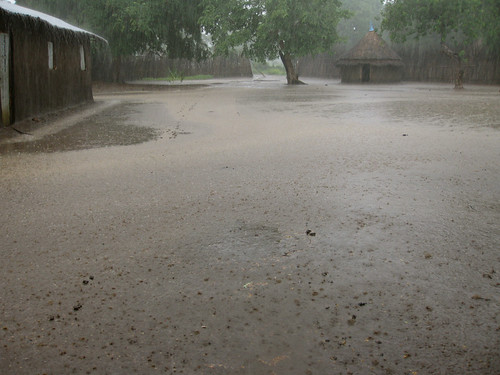
The group wasn’t quite ready for an election. Instead, it was a two-hour group session to get everyone on the same page on working together as a community to address and solve educational issues and the Early Child Development Program. It’s a tough challenge to try to get a group of individuals to take charge of a program to help themselves move forward. It’s even tougher in a place like Southern Sudan, where many people feel helpless and need direct aid—food and supplies. The trick of it is to avoid the aid dependence that occurs from simply freely handing out goods. The women are motivated though. They desperately want to learn. They want their children to go to school. They want to improve their economic lot. They want someone to teach them how to make soap. As refugees in Ethiopia, they had free schools and other services provided to them in Ethiopia. In Southern Sudan, they need to take the reigns and get involved in the school, get the training and skills to run the schools and programs after the NGO’s are gone.
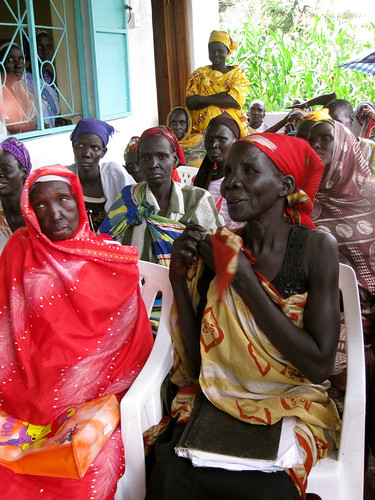
There was no election. But the women’s group is moving forward. Next Friday, there will be another community meeting to keep the momentum going and hopefully after that we can have the election and get the program structures in place. It’s slow, but at least its moving.

I took about three hours of film today. I’m having some trouble getting the audio quite right, but with a bit more practice, using my clip-on mic for interviews, and taking more time to think out my shots I should get it down. I’m getting a rapid crash-course in filming as I work. I just hope that these first few runs aren’t a total wash.

Thursday, July 10, 2008

Visit to the Maiwut Health Clinic

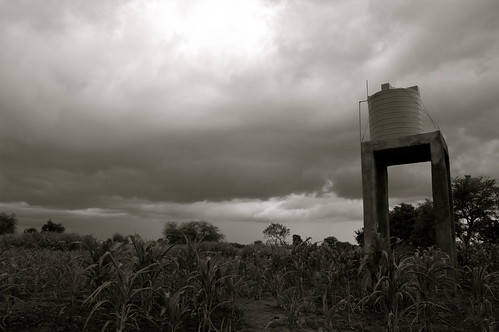
Today I went with Bernhard to visit the Maiwut public health clinic and meet with local community health mobilizer and document the facilities (read: take a picture of a non-functioning bore hole).  After the last intern had an unfortunate accidental photographic run in with the SPLA, we've been put under greater scrutiny and are subject to more Draconian regulation by the local Payam administrators.  

As part of the new rules that we hammered out when I met them the other day, we first stopped by their small office in the middle of town to ask one of them to accompany us to make sure no inappropriate photographs were taken.  The subordinate of the two administrators, a quiet Nuer guy, jumped into the back of the Land Cruiser and we raced off to Maiwut to head off the rain clouds in the distance.  Maiwut is about 22 kilometers from Pagak but on a mud "road" it takes just over an hour to get there.  

Along the way we stopped to pick up a few people who needed to get go in the direction we were headed.  This included a couple of old Sudanese ladies, one of whom was drunk and looked like she was ready to puke as car tossed people about on the bumpy road.  We swerved through the bush and avoided the muddy areas where cars usually get stuck.  As we passed people on the path, most got out of the way but a few just sort of stand there staring at the car.  One guy walking a defunct dirt bike stopped not far enough to the side of the road and we hit a real wet spot and slid into his bike.   About an hour later (and a few apologies to passerby later), the green tangle of grass, trees, and shrub began to thin out.  A lot of the small trees now had been chopped a few feet up from their base and I knew we were almost there.  We gave our hitch hikers the boot and pulled into the clinic.  

I met with Gach, the community health volunteer at the clinic and got a quick tour.  Bernhard and I went out behind the clinic to get a few pictures of the bore hole that had been recently drilled for water.  

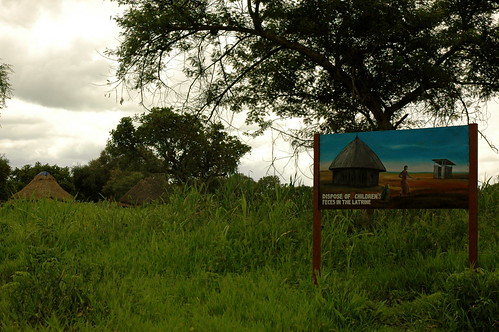
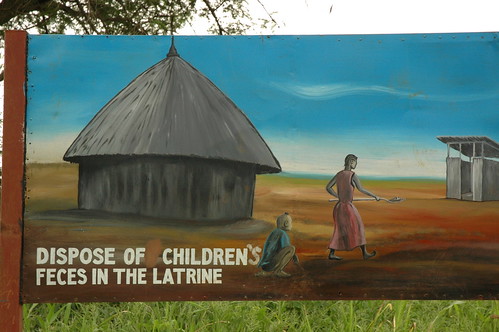
Out in front of the clinic was the only public awareness sign in the county.  I went up to it to get a closer look and was pretty amazed.


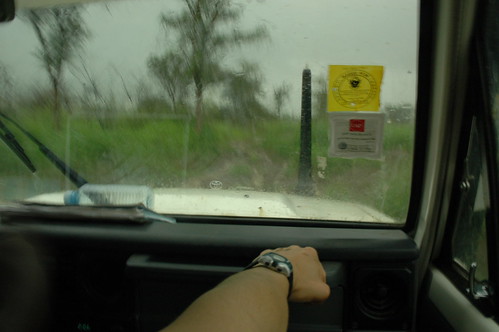
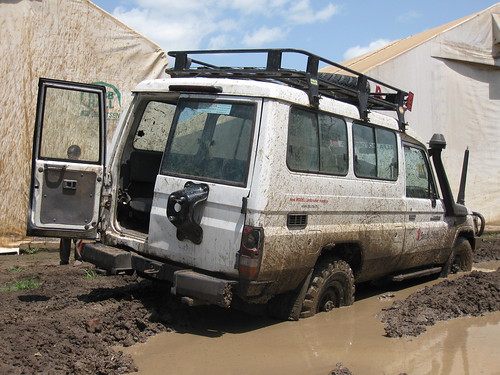
We didn't really have much time for anything more than introductions as the storm clouds that had been looming earlier were no longer just on the horizon and the sky began to open up.  We tore off home to get through the bad spots before the rain would make it impassable.  Impassable means sleeping in the bush for the night or ditching the car and walking home.  The ride that was merely bumpy before, took on a whole new dimension as the dirt path now became just a guideline for the direction to head.  We veered and skidded through the tall grass and through brush, with the car getting some serious air time.  At times, the LandCruiser couldn't get through the mud and needed some good old fashioned pushing.


Most of the time, we all just had to hang on as the driver did his best to power through the mud but avoid sliding off into the bush.  For the most part he was pretty successful.  At one point, though we fishtailled a little too far and the back of the car slid into a tree.  

As we approached Pagak again, more or less in one piece, the rain started to let up and the last leg of the road was not all that muddy.  Unfortunately, the drive had taken its toll on one of the locals riding in the back and she retched all over the back seat of the Land Cruiser.  And possibly all over the administrator who had insisted on monitoring my picture-taking.  At least that's what I was secretly hoping from the seat in front of him.  

Pagak itself was dry.  The storm had left it mostly untouched and we arrived in a muddy beat up LandCruiser covered in branches and leaves that looked entirely out of place considering the circumstances.  I was a bit dizzy by the time I stepped out of the car, and like a late-night drunk, sort of stumbled back and forth until I reached my room and the relative safety of my bed.  

Wednesday, July 9, 2008

Backlog 4: Nearly Home Again

We reached the Sudan/Ethiopian border by late afternoon. That particular border crossing is really little more than a dirt trail and a collapsed bridge. I quickly hopped up on the roof of the LandCruiser to unload all of the baggage and produce that we had carried from Gambella.

I had finished dropping down most of the bags up top, when I started to disentangle this big bastard of a woven plastic sack full of tiny red onions from the roof rack. Likely its many repeated uses and numerous days in the sun meant that any time I pulled at it to lug it upright, it developed a new tear somewhere and at one point the entire top section I had grabbed, simply tore off sending a few off the roof. As I got it over the edge, my lower back quickly send a signal that all was not well. I called Odongo to replace me up top and hobbled my way across the short metal bridge. The bridge itself is only about forty feet long, and seemed to be about ten too short. It had slipped down from one of the banks of the creek and had to be connected by a small four-foot wide concrete slab just large enough to fit a quad-bike across.

By the time I got to the other side, the shooting pain prevented me from moving much further and I went to chill out for a few minutes on another concrete block off to the side next to some maize and a tangle of brush growing on the Sudan side of the creek. The minutes turned to an hour and I laid back closed my eyes, and tried not to move. A bit later the quad-bike arrived, and Judith and Laura loaded up some bags and headed back to the compound with David.

I heard them drive off, the gearbox grinding and yowling as David quickly discovered the need to engage the clutch before the bike would go anywhere. Duncan walked back over the bridge and chatted with some local boys and again I closed my eyes and just zoned out. Although Duncan was not more than 60 feet away, being tucked away a few feet into the brush I felt very alone.

It’s strange. I didn’t feel alone in a panicky way nor one that made me wish for company. Despite the pain and the heat, I felt an incredible sense of serene calm. I started to listen, and look at everything around me. Lying back, I watched the stalks of maize bow gracefully to an approaching breeze. I counted one, two, then three giant grasshoppers clinging forcefully to the underside of the long broad leaves. A sharp gust of wind would trap and entangle the leaves. A few seconds later, “pop” the leaves would suddenly free themselves and the maize would return to its rhythmic swaying, one or two grasshoppers fewer.

I closed my eyes and listened to the insects, birds, and the kids swimming in the creek somewhere to my left on the other side of the maize and brush. To the other side, some kids and a few men gathered around a friendly SPLA soldier who had brought out a cassette player and started playing music that I could only assume was Sudanese or Ethiopian. Beyond the tattered flag flying above the small SPLA border outpost on the other side of the dirt path, a bunch of hawks were riding a hot air column in a lazy circle and slowly circled their way upward. A group of four boys, perhaps around six years old came and sat on the slab right next to me, not really caring that I was there but also making sure not to disturb me. They chattered away in clip bits of Nuer punctuated by quiet laughter. I watched them as they were talking and wondered what it must be like to grow up in the bush in a place like Pagak. They were so happy, like a couple of school kids just hanging out on a lazy afternoon. Yet their skinny arms and large bowl-shaped distended bellies belied the mood, quietly telling of severe malnourishment. The summer months mark an anxious patience, as the few crops that are planted must mature for a few more weeks before they can be harvested.

As suddenly as they came, the four kids ran off into the brush, and quickly disappeared after only a second, leaving only the sound of rustling plants and increasingly muted child’s conversation.

While I was laid out, entirely unmoving, birds, small butterflies, and a few other odd animals scuttled out of the bush. A small yellow bird landed sideways on one of the stalks of maize. As he hopped his way to the tip, the stalk gradually bent under his weight until I thought he might continue his dip all the way to the ground. He sat perched on one of the many grain stems, its stalk bowed in an upside down “J”, and pecked at the precious grain, sending small green husks off towards the ground.

The world looks very different lying down. There’s a strange sense of detachment, watching everything perpendicular to what the brain is accustomed to. A young man crossed the bridge with a reluctant cow and had to put all his weight into coaxing the animal to walk up the concrete connecting slab. Behind him, an old wild-eyed man quickly strode up with a limp yelling something angrily in Nuer at the man as both went over to the smiling but entirely disinterested SPLA soldier who was sitting and tapping his feet to the Sudanese pop. Occasionally, an old Nuer woman would cross the bridge, usually carrying supplies or a baby basket atop her head, look to the left and be somewhat surprised to find a laid out foreigner lazing about in the bushes. They would stare, offer a quick “Maale” (Hello) and continue on, singing or simply muttering to nobody in particular.

Eventually, I heard the mechanical “brrrrrrrrrr” of an approaching quad-bike and the moment was broken. David had returned and it was time for me to finish the last 15-minute leg of my journey home. For a moment, maybe an hour, I simply just was—existing with a heightened sense of the small details of life around me. For that moment in time, I felt like one of the grasshoppers in the maize, watching and listening until a gust of wind finally dragged me away.

Tuesday, July 8, 2008

Backlog 3: Gambella, Ethiopia

On the morning after the workshop, it was time to leave coffee, cold beer, and fresh delicious food. There was a problem for half of the Pagak crew—some of those without visas had arrived earlier that week to an airport with a closed immigration counter. Laura, Judith, and Joeseph (who had his passport, cash, and other documents stolen in Gambella a few weeks ago) had to make the 12-hour drive overland from Addis to the border. Duncan, David, and I hopped a quick 40-minute flight from Addis to Jimma and again from Jimma to Gambella near the border.

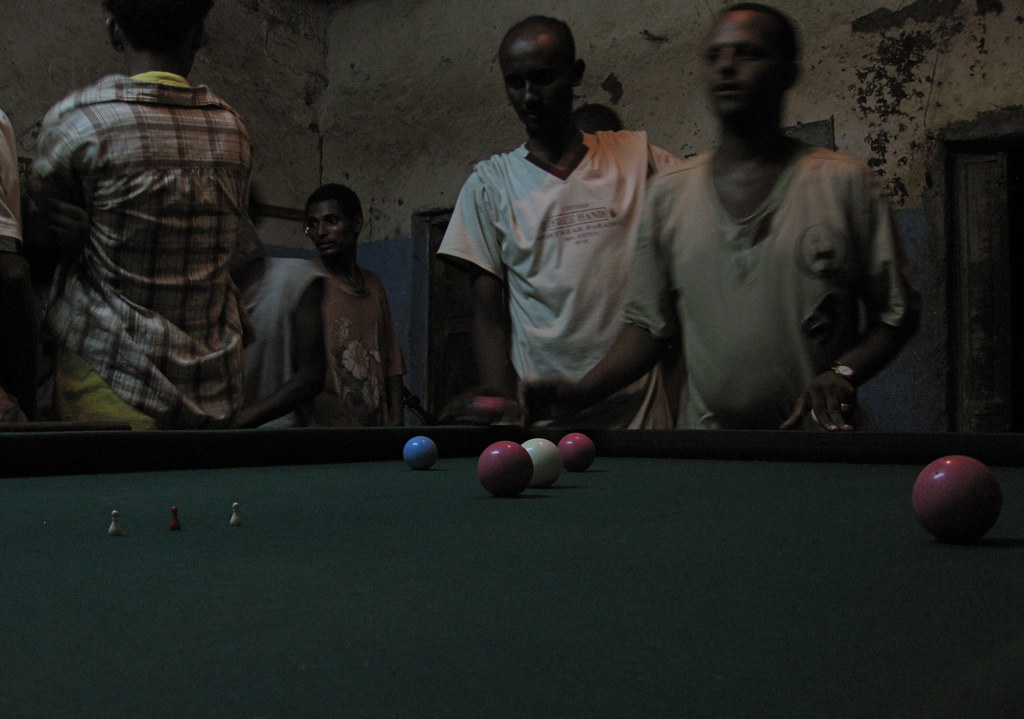
We had an evening as well as the full next day to putz around in the small town while we waited for the other crew to join us by car. The first night, we took a somewhat unsatisfactory meal (cold beef and potatoes) at the hotel and went into the town center where the market is. David and I went into a sort of dive bar (if such things really exist in rural Ethiopia) while Duncan did some printing next door at our contact, Teshome’s, shop. I sat down on a wooden bench against the wall of a small dark room that smelled like a locker room with stale beer poured across the floor and hazy cigarette smoke wafting in the air.

The main attractions in the room were two long tables that resembled pool tables with six undersized pockets. Teshome was challenging another guy to a game that’s name I can never remember. It took a while to figure out how the game is played, but it seemed to be a cross between pool and bocce. Players take turns throwing four balls at a blue target ball. At a base level, players must send their ball across the table to get it closest to the target ball while knocking the other player’s ball away. In the middle of the table, three tiny plastic pins resembling miniature bowling pins. A player received four points for knocking any of the pins over after hitting the target ball and two points for getting any of his opponent’s balls in a pocket. Each game takes about a minute and a half and players play until the winner reaches a specified number of points. A referee, who collects money from each player as well as bets from those watching the game, pays out the winner of the match and the process starts again with two players.

The next morning I hit the market early. The market is pretty small compared to others—some used clothing, tailors, and vegetables. I went to the other side to find a guy who makes rubber sandals out of used tires. He took my foot measurements and a few hours and two bucks later I came back just as he was putting on the final touches. I sat with him for a few minutes, chewing khat leaves from a branch he had offered me. Its bitter but after a while has a mild stimulant effect like caffeine or nicotine. While I was sitting, one man came up to me, told me that he had a brother in Canada and asked me to take me with him. As soon as I politely declined, another told me that he had a brother in Pagak and asked me to take him back with me when I returned. Again I had to decline.
I returned from to Teshome's shop at the edge of the market to find that somebody had started an argument with Wandera and an Ethiopian colleague over something none of us could understand.  He kept demanding to be taken somewhere, but wouldn't tell us anything more coherent than that.  He demanded to know who the lead driver of the vehicle was, and we each sort of buckpassed him off declining responsibility for the vehicle.  "Do you like your life?" he would ask each of us before mumbling something about the vehicle.  He came up to me with the same series of questions before telling me not to be afraid.  "Do you like your life?"  Thinking he was from immigration or the police, Teshome had him sit in the passenger seat and started to pull out all of our paperwork from the glove compartment.  That's when a friend of ours who knew the man gave us a "he's crazy" gesture and we followed him out the back door of the small store our car was parked in front of.  We escaped down an alley and had some tea while we tried to figure out what was going on.

Inside the car, the man suddenly grabbed the UHF radio and started calling in positions and other seeming nonsense although our LandCruiser's radio is not functional.  Eventually he demanded to be taken somewhere and smashed the windshield with his fist leaving a spider crack on the passenger side.  Judging from the damage, I can only imagine the punishment he had inflicted on his own fist.  Take him he did.  Teshome drove off with him to the nearest police station to sort things out.  

Over tea, our friend told us of how he knew the man from a while back as he had employed him in his store.  He was, in fact, mentally ill and in a prior incident he had upturned and stoned a parked motorcycle.  He was bright to be sure.  His English had only the slightest trace of the strong Amharic accent in Gambella.  He had worked for Medecins  Sans Frontieres as a radio man calling in the car's position as it passed through checkpoints.  His mother had died a few years earlier.  His father had similarly fled Ethiopia for Kenya during a flare-up of community ethnic violence only to die during the political violence in Kenya this past December.  The day before, his father's remains arrived in Ethiopia.  As I heard his story, I went from feeling confused and angry to sort of just numb.  How are you supposed to feel in a situation like that?  Suddenly the moral clarity of the situation simply disintegrated.  I heard that there is a state mental health treatment facility in Addis that he might be taken to for treatment.  I seriously hope that is what happens.  I hope that he is not treated poorly at the police station.  It makes me sad to know that this is not likely to be the case.

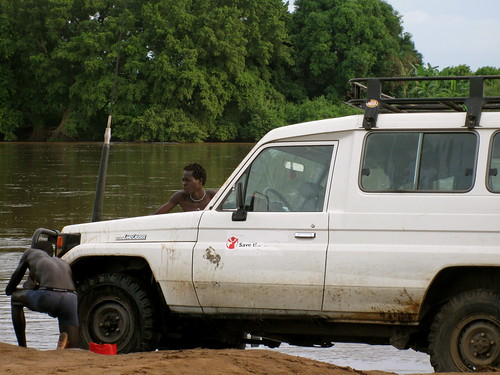
We finished our tea and continued on.  From the market we took the LandCruiser to the river to have it washed. We headed back in the direction of our hotel, stopped short of the bridge that separates the outskirts of town from the market, and pulled off onto the dirt road that led to the riverbank below. About two-dozen men were bathing on the riverbank and amongst them were a group of young guys throwing soapy water on a shiny new white Mercedes SUV owned by a church group that was half parked into the river.

We pulled our beaten up LandCruiser in front of it, paid a guy 30 Birr (about USD $3) and watched them take of months of caked on dirt and grime. While the LandCruiser was getting a facelift, we crossed the bridge and headed down to a construction site on the opposite side of the river. A new little hostel/hotel is being built on the bank of the river where we will eventually stay for future cross-border trips. Our local staff guy started chatting up one of the construction workers and we sat talking and chewing fresh khat for about an hour. After an hour, we thanked him for the khat, picked up our car from the river, and headed back to the hotel to meet up with the overland group to retire for the night. The next morning, we hit the local market to stock up on kilo’s of beans, cabbage, onions, and other fresh food for the next few months. 


We tied down our bags as well as well as the newly purchased sacks of freshies to the rack on the roof and piled in. Since it hadn’t rained we were able to take the LandCruiser all the way to the border, where we were met by one of the ATV’s for the last 15 minutes of the journey.

Monday, July 7, 2008

Backlog 2: Addis Ababa

Ethiopia is a pretty groovy place. We first had spent the night a hell-hole hotel in Gambella where the overflow rooms may once possibly have been a cinder-block restrooms with rusty orange water leaking from the toilet and walls. The Gambella airport is more of an airstrip, one runway and a lone building that more resembled a school portable than anything else. We were told the day before that the president was in town. Not the president of Ethiopia (Ethiopia has a parliamentary system) but the president of Gambella. He had stayed at our crappy hotel the night before and the dozens of blue camouflaged police sitting in the forest with their Kalashnikovs across their lap testified to his presence. The same entourage showed up to the airport in a tinted car and the same police fanned out in the field across the airstrip. The flight from Gambella to Addis was short—only about an hour, but an hour by plane makes a huge difference in where you are living.


Addis is up in the highlands, where it rains nearly every afternoon but is neither hot nor humid. There is a nice blend of Orthodox Christian and Islamic culture and you can smell amazing food (doro wat, shiro, and a slow cooked boiled beef) as you pass by the small local restaurants. We stayed at the International Livestock Institute, which despite the name is very cool. There was no livestock although there were plenty of people running around in white lab coats. It is more of a huge compound with beautiful landscaping, friendly guards in funny uniforms, and comfortable hostel rooms and access to the InnerTube. Best of all, the rooms had running hot water and a large bathtub, although the general water shortage in Addis meant that it was only available during parts of the day.


About 20 of us came from all over Sudan for a retreat to get everybody on the same page with the different programs that Save is running in the South. Given the state of infrastructure in Sudan, it was actually far cheaper to send everybody to Ethiopia then spend 150 bucks a person
 to house staff in a tent in Juba. Not to mention that The Plane only comes to Pagak every Thursday and only if there has been no rain during the previous week.

The workshop itself was fine. A presentation and overview of the Sudan Office’s programs was helpful in getting me up to speed with strategy and Save’s program plans for the next few years. The next few days were spent going over and smoothing management issues—logistics, grant management, procurement cycle, etc. that while not too pertinent for we three interns, but at least gave us a better idea of the day to day issues and problems involved in running an NGO.

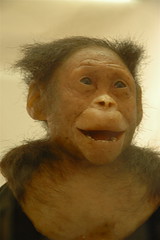
Best of all during the first day, the Pagak crew had some free time to do some exploring while everybody else flew in late from Juba. Judith and I went to the National Museum at the insistence of the taxi driver and saw some sweet archaeological finds, including this—a 3.3 million year old fossil of a child australopithecine (and an artistic rendering thereof) that was recently discovered in Ethiopia.
Artistic Rendition of the Dikka Baby Fossil
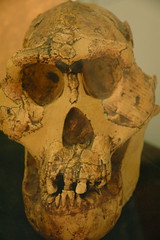
Cro-Magnon Skull
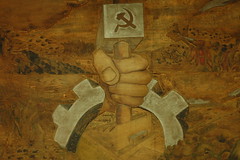
Iron Fist
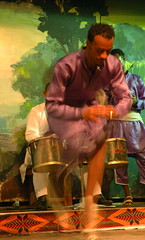
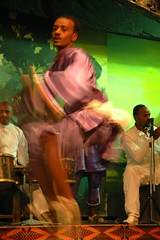
On Thursday night, we all went out to an Ethiopian restaurant that had live music and dancing. The four man band had a guy on flute and three on electric versions of traditional string instruments. At one point (after a few drinks it should be noted) a few of the Kenyans in our crew joined the dancers on stage. Charles, David, and Joseph went up to help one of the singers with a song in Swahili. The singing continued on the bus ride home with a song list ranging from crazy gospel to The Beatles to country.
Ethiopian Dancing 2Ethiopian Dance 1
During the week, it seemed everyone got sick at least once—either from the rapid change in altitude, or from bad food somewhere. My second day, I discovered Ethiopian coffee—about ten cents for a perfect espresso. Combine that with a bit of equally cheap whiskey and a forgotten reminder to drink water and I found myself down for the count one night with some funky altitude sickness. I couldn’t really sleep or find one of the friendly guards who usually patrol outside to pester for some water. At about four in the morning I got a hot water pitcher, filled it up with city water from the bathroom and boiled it for a good 20 minutes. I didn’t realize that it would be about another hour before the water could cool down enough to drink. I threw back a few Advil and gingerly downed the pitcher of still hot water, with just enough time to catch an hour or two of sleep before the morning meeting.

Sunday, July 6, 2008

Backlog 1: After three days in Pagak, off to Ethiopia

We were lucky. We needed to cross the border to Ethiopia and when I woke up in the morning, it looked like rain. We have a Land Cruiser sitting at the Police station in the Ethiopian town of Kuegan, about 25 km from Pagak. If it had rained the night before, we were to put on the Wellingtons and slog our way to Corgan on foot.

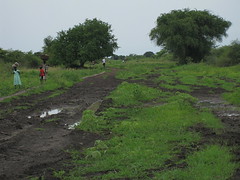
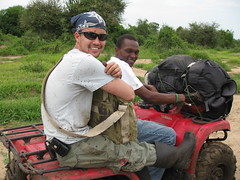
Our luck held and the dark morning clouds never transformed themselves into the torrential downpour that usually turns the loose clay dirt into a mud bath. Two days earlier, an attempt to leave the compound by Land Cruiser was aborted 20 meters past the gate when it got stuck in the mud, as did the truck sent to wench it out. With the ground muddy yet passable, we loaded the two ATV’s with our luggage and crammed ourselves onto whatever space was left on the bike. Two guys ferried four other of us to Kuergan, only to turn around and make the trip again with the remaining staff.


Although the area around Pagak is sparsely populated with little vegetation, we found ourselves increasingly deeper in the bush. The trees grew larger and more densely packed together. Tall wild grasses grew to the sides of the narrow road and occasionally would slap us in the face as we maneuvered around muddy ditches. We passed a lot of tiny villages with friendly Nuer who smiled and waved at us as we passed by. 


There were also hundreds of Sudanese walking the same path to Kuergan—a walk that takes about six hours. Strong tall women balanced baskets of supplies, or gourds full of water on their heads as they were returning to Pagak county after purchasing needed goods across the border.

At one point we crossed the border—a concrete slab that spanned a narrow stream. Jimmy had to gingerly navigate the ATV down a small concrete ramp that was just a few inches too narrow for it. On either side a couple of bored looking soldier sat in a chairs watching people go past. No ID checks, no questions, just cross the bridge and you are in Ethiopia. Should you need to avoid any entanglements with the authorities, it would have been a simple matter to just hike around the “bridge” and cross somewhere else.

Although it hadn’t rained the night before, the dirt path (road?) was still incredibly muddy. Bits of mud and cow crap would get flung up from the ATV’s tires and pelt passengers and passerby alike. At one point I had let go of my bag and it slid around my shoulder and hung off to the side of the vehicle. By the time I had pulled it back into my lap a second later it was already coated in mud.
Mudding it Up
After about an hour, we reached town. Compared to Pagak it was a sprawling metropolis but, in reality, it probably only has about ten thousand residents. We waited to get cleared at the police stationed and, after about a minute, they opened up the corrugated metal gates and let us in. A squad of heavily armed policeman gathered were gathered just sitting and hanging out to the side of one of the buildings with their Kalashnikovs in their laps, laid against a tree, or on their backs. Not far away, next to a few guys hanging out around a couple of dirt bikes, was our Land Cruiser. And not far away enough was a bit of a sausage party, as some of the policemen were taking a bucket bath and keenly watching the new arrivals.

The ATV’s and their drivers turned around to pick up the rest of the staff and we quickly tied our luggage to the roof of the Land Cruiser and checked to make sure it would still start. We had about three hours of waiting time, so we went to the local “hotel” and ordered a liquid lunch—two warm but delicious St. George Ethiopian beers. We then hit a small shop where we had a bit of tea and then it was back to the Land Cruiser for a short nap.

After the rest of us made it to the police station, we took the Land Cruiser on a bumpy hour’s ride through the green lush Ethiopian countryside to Gambella, the city where we were to stay the night and fly out of the next morning to Addis Ababa. Along the way, there were a bunch of crazy birds, a baboon, silly pheasants, and even a Gennet cat. After a series of detours, wondering which dirt path to take, and past several “Crushing Stations”, we pulled into Gambella just as night fell. We checked into the hotel and I began trying to wash off layers of caked mud in shower that looked like somebody had just died in it. After dinner, I hopped back under my mosquito net, and penned this entry. A pack of dogs had just started a fight outside my room and I contemplated where I had placed my E-ticket from the day before.

Backlogs and Videos

I just got back from Ethiopia this evening and have some backlogged videos and entries.  I'll try to get them up as soon as I can, provided the generator doesn't break down again.  Enjoy!

Video from the Vegetable Market in the small but lively Juba Marketplace.


Landing in Nasir where we made our first cargo drop.  I couldn't really see out the window so I just leaned out the car window and pressed the camera against the plane window that was a few feet below me.

Friday, June 27, 2008

Cargo Drop

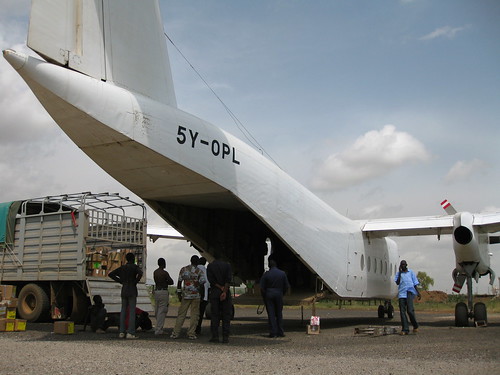
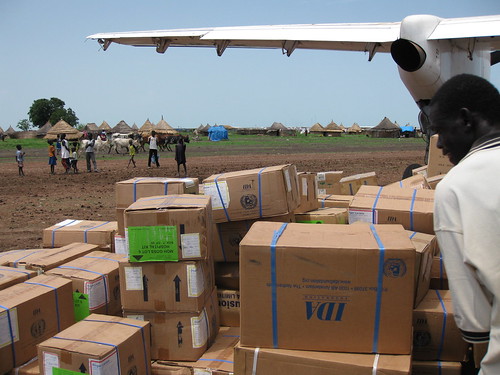
From Juba, I took a mid-day cargo flight to Pagak.  In the morning I rushed around town to get my exit visa from the Immigration office before we head to Ethiopia.  I returned just in time to catch a ride to the airport in one of our Land Cruisers.  Thursday is the day the Buffalo flies.  The Buffalo is an older two prop workhorse of a plane that can haul up to six tons of anything across the country.  The rear of the plane has a cargo ramp.  You load/drive your cargo up and away you go.

We followed a huge truck filled with supplies, drugs, and other medical equipment to the airport, nodded to security, and drove on out to the runway to the plane.  On the far side of the runway, a huge white UN C5-type cargo plane was unloading supplies into canvas covered trucks.  The truck in front of us mistakenly raced off to the other plane and had to be called back.  As it pulled up to the Buffalo (a white Buffalo at that), six guys jumped off and we began to unload several hundred boxes and pack them into our plane.  First though, we took off t
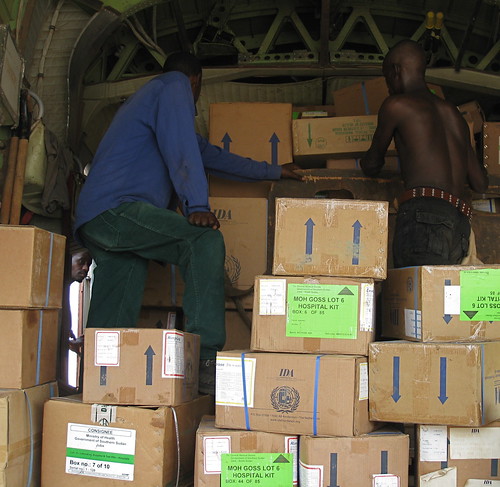
he radio antenna from the Land Cruiser, deflated the tires, and drove it into the cargo bay of the Buffalo.  Once fastened down with straps, we started transferring the boxes to behind the Land Cruiser and anywhere else there was room.  It took a long time to move all those damnable yet lifesaving boxes by had.  I had stupidly packed my empty water bottle away earlier that morning and the runway was radiating the full fury of the midday Juba heat.


About an hour later, as we were finishing up, the three-man flight crew wedged their way from the tiny door in the fuselage past all of the boxes and the Land Cruiser and took up positions in the cockpit.  Some other guy I had never met before and I got into the car and the rest of the boxes were placed around the side of the Land Cruiser pinning us snugly in place.

As the Buffalo cranked up its engines and slowly, but powerfully, made its way airborne, the inside of the car started to hit at least a roasting 50 degrees C with full humidity.  Since I couldn't turn on the air conditioner, I thought that I would be a smart ass and  roll down the window, put one hand on the wheel, lean my arm out the window, and pretend that the roar of the engine was actually that of the six-piston Toyota and that I was cruisin' down the street.  "That's right, ladies.  What up?"  I thought, staring at the boxes tapping against the back window trying to get in.  The guy sitting in the passenger seat ignored me and pretended to sleep.  As my two backpacks vibrated their way off of the hood, the effect was thusly ruined and my short-lived fantasy came to an end.

The flight itself took about an hour and a half.  Once we had been airborne for a while and the plane started to cool off, I dug into my bag and found the German Capri-Sun that I had stowed away in Nairobi.  Now 30% weniger Zuker!" it informed in on the front.  We passed the enormous Nile River, a lot of green pastoral land, sparse forest, and I knew we were far away from Juba.

We touched down somewhere.  Maybe we were already at Pagak, but I couldn't really see out the windows with all of the boxes in the way.  As I exited the vehicle and sidled past the boxes, I followed the crew out the passenger hatch on the side, jumped down, and fought the blinding light to see where I had ended up.


The second I jumped off the plane and looked around, I was instantly taken aback for a second.  Standing in front of me were about 50 people just kind of curiously looking at the plane and the sort of Asian-white guy that it had produced.  About a hundred other people came running towards the plane as a guy started to shoe the kids away with a big stick.  Fo
r about a minute, I found myself completely alone wondering what to do.  The sleepy guy wandered off somewhere and was nowhere to be seen.  Do I find somebody?  Do I continue to stand there like an idiot?  I chose the latter.  A second later, a Save the Children Land Cruiser came driving from the village and the local program manager welcomed me to Nasir.


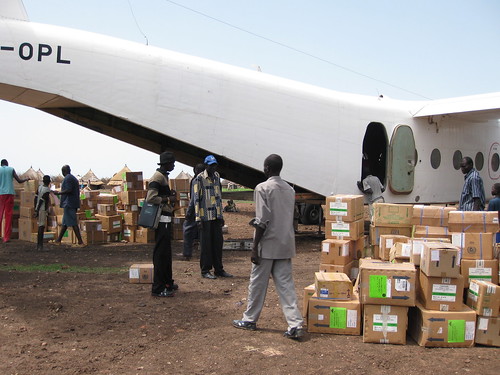
We enlisted the help of some of those standing around, and unloaded all of the boxes from the back of the plane and stacked them up on the dirt runway.  It only took about a half an hour and a gracious medical staff thanked us for the supplies.  The Public Health Community Center in Nasir had been absent drugs and basic medical supplies for quite some time.  I jumped back into the cargo hold, found a seat this time, and we took off again for Pagak.

The Pagak airstrip is literally right next to the compound and the rest of the town.  You could toss your stuff over the wooden fence and it would probably end up next to one of the brick rooms we stay in.  A bunch of smiling people greeted me and I finally met Judith, Laura, Jimmy, and the rest of the Pagak SC staff.  They gave me a warm welcome and helped to settle me down in what will be my new home for the next two and a half months.

Wednesday, June 25, 2008

On Abyei

For the past few days, I've set myself up in the Operations office where there was a free bit of desk.  Its not usually too busy except for the guy in the radio room calling whoever needs to be called and the static he usually gets as an answer.  The other guys in this particular office are pretty easy going and someone is either playing some hip-hop or Ethiopian music on their computer.

Today, John, a staff guy from Abyei came into the office urgently needing to send an e-mail to someone in Khartoum to clear up a finance issue.  I loaned him my computer and we started talking about how things have been going up his way recently since last months fighting.

In the middle of May, BBC and the other major newswires had reported a major three-day clash in the contested area around Abyei town.  Abyei is a currently a special administrative area whose territorial status was to be determined by the Abyei Boundary Commission and a future referendum.  At the micro-level, there has been conflict between the local Dinka, nomadic Messeriya herdsem who claim grazing rights, and Khartoum backed Messeriya militias.  Political elites on all sides have mobilized and armed followers using ethnic appeals.  Abyei holds immense economic importance to both the Northern and Southern governments, with 2005-2007 oil revenues of USD 1.8 billion.  There are also elements within the National Congress Party and the Messeriya who may see violence as a tool to re-negotiate the Abyei Boundary Agreement or even scuttle the CPA.  Consequently, Abyei in recent months has threatened to become a national flash point for the return to war as the Sudanese Armed Forces, SPLA, and local militias were deployed to the area in increasing numbers.  Last month, things began breaking down in a big way.

John, it turns out, works for a Save the Children program in Abyei town and was there when the violence broke out.  It was my first time to hear from someone what actually had gone on during those days when the fighting was worst.  He heard gunfire late one night as SAF units and the local police had a skirmish.  The next day the SAF moved in with more troops and clashed with units of the SPLA who increasingly deployed more heavy weaponry.  On the 20th, SPLA forces attacked the SAF camp in Abyei town and began setting up checkpoints in the areas under their control.  The SPLA began checking people's ID's and whether they could speak the local language.  If a person was found to be Arab, he was in a world of deep shit.

A month later, the town is much quieter.  The governments of Khartoum and Southern Sudan agreed to deploy Joint Integrated Units to maintain peace in the area.  Both also reached an agreement to use international arbitration to settle the boundary dispute.  NGO's immediately resumed their services and projects.

Yet the town is nearly entirely destroyed.  Most buildings had been either shelled or burned to the ground, as were any vehicles and motorcycles left on the road.  Vacated NGO compounds were torched in the fighting or, more likely, by looters.  John told me that one of the few things left at the SC compound was the enormous safe with their cash.  It was too big to haul away and crude attempts to open it would have destroyed the cash inside.
The human cost though is staggering.  No one is really sure how many were killed during the fighting, but as a result, over 50,000 were displaced and the town still faces and emergency situation.  John tells me that their most pressing need is potable water.  A river runs near the town, but the water is unusable.  Many more bore-holes are needed. Fast.  Although the fighting has ended, a major disaster clearly remains.  Those worst affected now are sadly those who have the least to do with the conflict.

Tuesday, June 24, 2008

From the marketplace I made my way towards the Nile, which borders one side of Juba (maybe it cuts through it-I'm not really sure).  In the area along the bank where I made my way to, there were a few Kenyan bars and guesthouses.  Although I saw a bridge upriver where you can cross, most parts of the bank that I could find were all fenced in with
 chain-link.


From the other side of the fence I sat and drank a Stoney ginger beer from the Kenyan bar and watched two Chinese guys fishing for Tilapia.  The bar was playing a mix of African reggae and American songs from the 70's.  For a moment I felt pretty absurd sitting in the shade and watching the slow lazy river, sipping a soda, and listen
ing to Willie Nelson.  Hell, I've never even listened to Willie Nelson in the states.

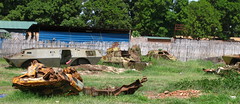
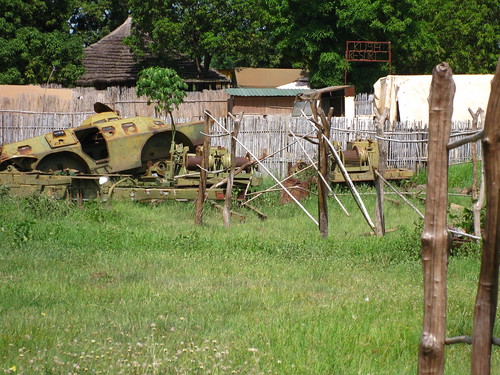
From the Kenyan bar, immediately I found myself confronted by a serious juxtaposition.  I could still hear the pulsing reggae music behind me but in a field sitting outside the gate, some old Armored Personnel Carriers from the war were sitting abandoned and rusting in a nearby field.  I took a few quick photos despite knowing that such things could land me in a bit of trouble (no more, I promise).  

Walking further down the road, the side of the road was littered with more and more derelict APC's that seemed like they hadn't been touched for at least a decade.  In between their old metal corpses, rows of wooden houses and thatch roofed tukuls stretched from the road into the field next to it.  Families went about their business.  I found myself stopped for a moment when, wedged between two of the houses was a broken-down rusted tank with some kids sitting on the destroyed turret.  I could still hear some old 1970's country music coming from the river.


Juba's a funny city.  On the one hand it as changed radically in the past few years.  Its population has swelled, roads have been put in, the airport is bigger, and at night you can visit the city's new hotels and dance clubs.  Security in the city is pretty calm and there is no heavy military presence in many of the public areas.  Even compared to Nairobi, soldiers and armed police are scarce.  Yet sometimes you find relics of a time that was really not that long ago.  I find myself reminded that the CPA is only three years old.

Even when we try to forget, abandon, and move on from the memories of war, sometimes they just continue to sit, staring at you silently from the side of the road.


Juba Marketplace

Lately, I’ve been trying to get away from the compound to walk around Juba. Yesterday, I managed to find my way to the Juba marketplace, which was only about a 15 or 20-minute walk away. I really miss the throng and frenzied activity of markets in Cambodia and Malaysia. The one in Juba is a bit smaller, but certainly does not disappoint.

The market itself is divided into ethnic enclaves—Sudanese, Kenyan, Ugandan, and others. Over the random music blaring from many of the stalls, you can hear a chattering of Swahili, Juba Arabic, and many other local languages.

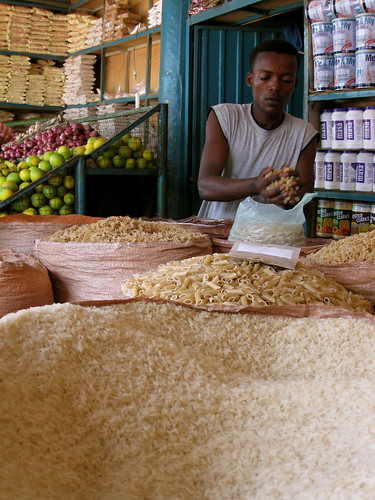
Along the main road that cuts through the market separating the upper third from the rest, there are kiosks hawking sodas, fruit, and used clothing called Mutambo. There were a lot of people stopping into small stalls, “saloons,” to have their hair cut or braided. If you duck off of the main road and into the narrow maze of stalls, you have to push your way through a bustling vegetable market where you can buy leafy greens, several types of bananas, as well as relatively fresh meat. A loaf of bread costs about 10 Sudanese pounds (about 5 dollars). Juba really is one of the most expensive cities in Africa with a rapidly growing civil service and heavy NGO presence that causes the demand for most goods to skyrocket. Given the Southern Sudanese economy’s post-conflict lack of industry and poor infrastructure, a lot of the goods, and particularly produce must be imported from Uganda.

Pushing deeper into the market, there are larger buildings where old gas powered machines crush grains and seeds into a fine powder. There were also several shops where five or six men stripped were sitting and stripping old used tires and sewing them into black rubber sandals.

People of all types were crowding the narrow passageways between stalls, although Westerners were conspicuously absent. Juba, in general does not have much of a visible military presence. However, at the market, there were Toyota trucks with the backs filled with heavily armed SPLA soldiers patrolling the main street. In greater number however, were the soldiers perusing through stalls, buying goods, and chatting with women who eagerly tried to hawk them whatever it was that they had to sell.

I didn’t take any pictures so as to avoid being a jerk to everyone there, but I did enjoy just walking around and chatting with people. Juba Arabic is not so similar to Egyptian. Combined with a lack of English, communication is quite a challenge.

I did manage to take a short video from inside the vegetable market, but given that the shared satellite Internet is usually far slower than dail-up, I doubt that I can get it uploaded anytime soon.

Saturday, June 21, 2008

SC Alliance Kickoff Ceremony

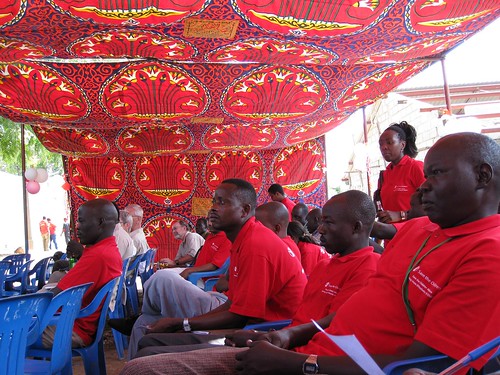
This morning we had a kickoff party at the compound to celebrate the merging of operations between Save the Children US, UK, and Sweden.  The three organizations have operations in 8 of the 10 districts in Southern Sudan with not too much program overlap.  Beginning today, they will operate from the same compound and pool resources and programs to improve cost efficiency and improve communication.

There were a few government officials as well as the country directors for different NGO's and UN agency's in attendance.  From right to left: Country Director for Save the Children Sweden, Representative for the Minister of Gender, Social Welfare, and Religion, and the Minister of War Heroes.


The staff and invited guests listen to speeches and discussion of program areas:


Together, the new partnership, called Save the Children in Southern Sudan, will have 429 staff and operate programs in education, early childhood development, health, water and sanitation, child protection, and thedemobilization and reintegration of child soldiers.  

Mattito Watson, Country Director for SC US gives a speech before cutting the ribbon:


After the ribbon is cut.  From right to left: Country Director UNICEF Sudan, Mattito Watson Country Director SC US, Country Director SC Sweden, representative for the GOSS Minister of Gender, Social Welfare, and Religion:


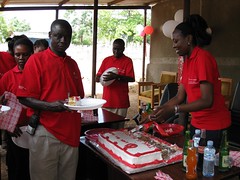
Cake!


I will try to get some photos of Juba up but I will link them off of my Flickr page to avoid uploading twice.  The satellite internet is pretty sketchy and photos take about 20 minutes to upload.  I'll upload them at night so as not to eat up all of the limited bandwidth.   


Still in Jubtown

There were some logistical problems with the cargo flight that I was planning on taking to get up to Pagak today.  It looks like I will be in Juba for a few more days unless something opens up.  Today there is a ceremony with SC UK and SC Sweden and some other NGO/UN officials.  The Nairobi office that had previously administered much of the Sudan program has now closed down and the Juba office will be the base for SC's Sudan operations.  I'll let you know how things go today.  

Friday, June 20, 2008

Made it to Juba

At the end of my first week in Nairobi, I finally got my luggage situation all sorted out.  Once the call came in that they had found some luggage that may or may not have been mine, I didn't really care--I was just glad to talk to somebody who didn't keep blowing smoke up my ass and telling me to be patient and that this was all a process.  After getting cleared by security and talking with the baggage guys for a while, I found both of my backpacks under a pile of suitcases pretty much in the same condition I had sent them.  Every night I kept imagining them wandering around Nigeria somewhere and had pretty much given up hope that they would be found.  Not too bad.  I celebrated by eating three lunches.  Justice baby!  

I took a ten o'clock flight from Nairobi to Juba, Sudan, which lasted about an hour.  After touching down at the airport and stepping out on the tarmac, I was a bit taken back by the sudden change in weather.  I had gotten used to the nice cool air in Kenya and forgot what it was like to like in a hot humid hell.  Today actually was just fine, but I had apparently gotten spoiled in Nairobi.  Juba airport is not so big.  Mostly its just a huge runway with a large building to the one side.  Two huge white UN cargo planes were taking off and several of the white UN cargo choppers were sitting in the grass.  Walking inside, I was greeted by a sign from an oil company welcoming me to Juba and Southern Sudan--"Our Country, Our Land, Our Oil, Our Liberty."  

Juba is a huge city.  More in size than in population.  The dusty streets are filled with white Land Rovers as well as teenagers on motorcycles.  The Save the Children compound was only about a 15 minute ride by Land Rover from the Airport.  The Country office is composed of a couple of small buildings surrounded by a brown wall and a gate.  There are about 20 staff and everybody has been very friendly.  Juba is a safe city--one of the safest in Africa.  Sometimes though, people do break in to the NGO compounds looking for anything of value.  Late last night, the SC compound was hit by a small group who beat up the guard and wrecked the safe.  

The guesthouse is just a short walk down the street.  I'll head over there once the generator cuts off at 7 (in about 20 minutes).  I'm excited to head out to Pagak tomorrow.  It hasn't rained for about a week so the ground out there should have dried up enough to walk around without it becoming a mud bath.  

Thanks everyone for all of your help and support this past week.  Even without having any of my stuff, I felt great just knowing that I have such a good group of friends.    

My next update should be from Pagak.  One of these day's I'll try to get some pictures up.  

Thursday, June 19, 2008

Headed to the airport...

...to follow up on a call that some bags may have arrived.